
This is one of the most common questions we get, and it deserves a direct answer rather than a deflection.
Lab-grown diamonds generally do not hold their resale value as well as natural diamonds. That is a real and meaningful difference. But resale value is only one consideration when choosing a diamond, and for many buyers, it is not the primary one.
Here is how to think through the full picture.
Three Types of Value Worth Separating
When people ask whether a lab-grown diamond holds its value, they usually mean resale value. But there are other ways buyers think about value too, and separating them makes the comparison much more useful.
- Resale value is what you might recover if you sold the stone later. The secondary market for lab-grown diamonds is currently limited, and resale values tend to be considerably lower than their original retail prices. Production has also become more efficient and supply has increased, putting continued pressure on lab-grown diamond pricing. Natural diamonds generally have a stronger resale history, although their resale value is also often substantially lower than what was originally paid at retail.
- Personal value is what the piece means to you and the person wearing it. Lab-grown and natural diamonds have essentially the same optical, physical, and chemical properties, but their origins are different. For some buyers, natural origin carries significance. For others, it does not. That is a personal preference rather than a question of quality.
- Visual value is how much size, cut quality, color, clarity, and overall presence you can get within a particular budget. This is where lab-grown diamonds can offer a significant advantage. At the same budget, a lab-grown diamond can typically allow a buyer to choose a larger stone, higher specifications, or leave more of the budget available for the setting and overall design.
Why Lab-Grown Diamond Resale Is Low Right Now
The lab-grown diamond market has changed quickly as production technology has improved and supply has increased.
At the same time, a mature and consistent secondary market for previously owned lab-grown diamonds has not developed to the same extent as it has for natural diamonds. That combination has resulted in relatively low resale values.
It is something buyers should understand before purchasing.
It is also important to put resale into perspective. Engagement rings are generally purchased to be worn rather than resold, and natural diamonds should not automatically be viewed as financial investments either. Natural diamonds typically retain value better than lab-grown diamonds, but neither category should be purchased primarily with an expectation of financial return.
When Lab-Grown Can Make Sense
For many of the clients we see at The Diamond Room, the lab-grown versus natural decision comes down to what they are trying to accomplish.
Lab-grown may make sense when the priority is a larger center stone within a defined budget, higher diamond specifications, putting more of the overall budget toward a custom setting, or simply when future resale is not an important part of the decision.
A lab-grown diamond compared with a lower-quality natural diamond at the same price is also a different comparison than lab-grown versus a well-cut natural diamond of equivalent quality.
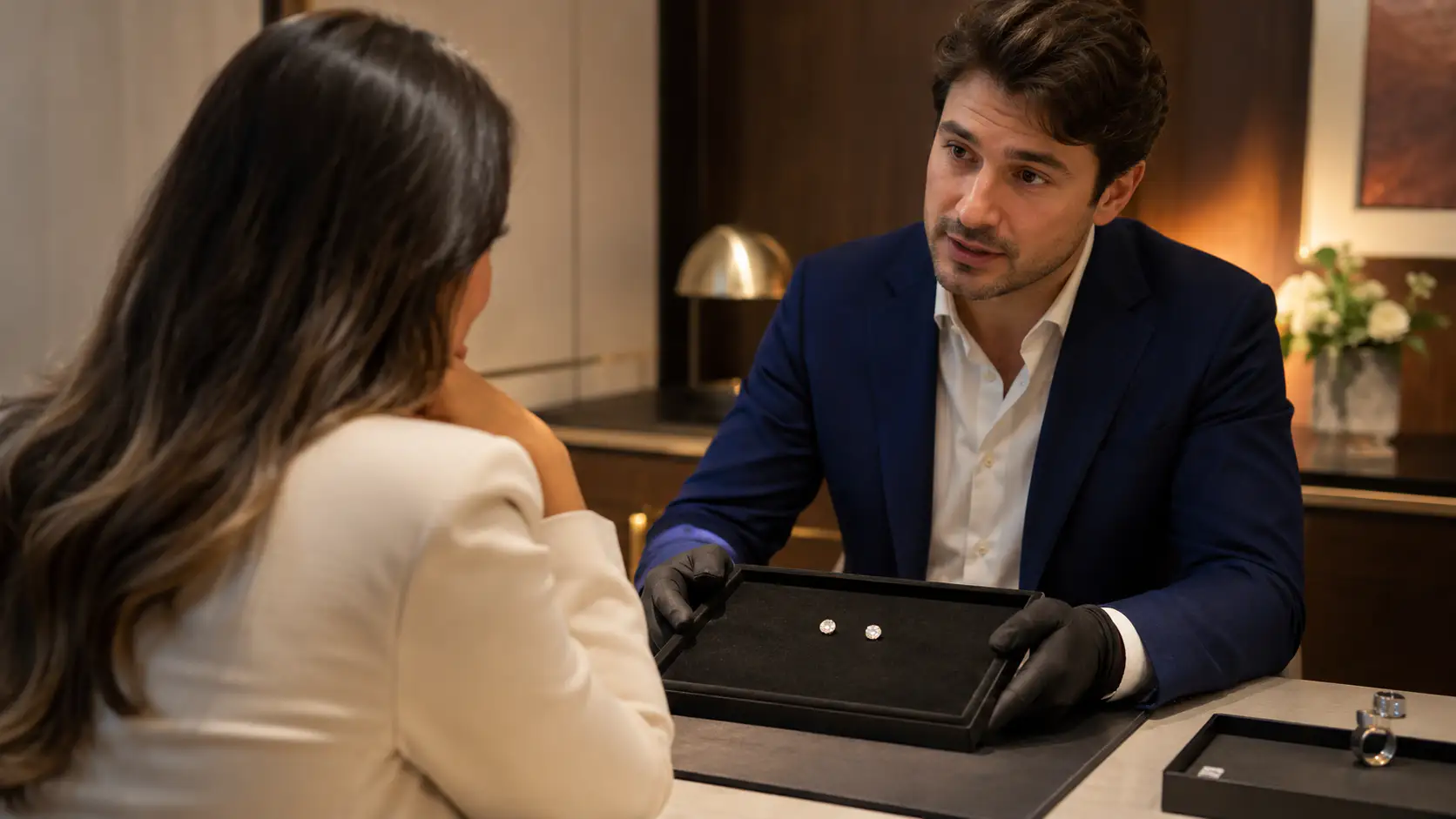
Whenever possible, we prefer to show clients the options side by side so they can compare actual diamonds rather than make the decision entirely from specifications on paper.
The Texas Cut: A Lab-Grown Option
The Texas Cut is a patented faceting pattern developed by The Diamond Room and currently offered in lab-grown diamonds.
For clients who are already considering lab-grown, it provides another option beyond traditional shapes such as rounds, ovals, cushions, and emerald cuts. Its faceting pattern creates a distinctive appearance while incorporating a connection to Texas into the diamond itself.
It is one more example of how choosing lab-grown can open different possibilities depending on what matters most to the person buying the diamond.
What We Walk You Through at Your Appointment
We do not have a preferred answer when it comes to lab-grown versus natural diamonds.
We carry both, and our sales team does not work on commission. Our role is to make sure you understand what you are looking at and what the differences actually mean before you make a decision.
That includes comparing lab-grown and natural diamonds within your budget, looking at size and quality side by side, discussing realistic expectations around resale, and determining how each option fits the design you have in mind.
When you are ready, you can see both options in person during a private appointment at The Diamond Room in Austin or Dallas.
Frequently Asked Questions
Do lab-grown diamonds lose value over time?
Lab-grown diamonds currently have significantly lower resale values than natural diamonds, and continued increases in production and supply may put additional pressure on pricing.
Whether that matters to you depends largely on why you are buying the diamond. If the intention is to own and wear the piece for many years, future resale may be much less important than size, quality, design, and budget.
Are lab-grown diamonds a good investment?
A diamond should generally not be purchased primarily as a financial investment.
Natural diamonds have historically retained value better than lab-grown diamonds, but resale prices for natural diamonds can also be substantially below original retail prices.
If financial return is the objective, a diamond is very different from a traditional investment. If the objective is owning and wearing a beautiful piece of jewelry, the considerations are different.
Is there any visual difference between a lab-grown and natural diamond?
Not necessarily.
Lab-grown diamonds have essentially the same optical, physical, and chemical properties as natural diamonds. When two diamonds have comparable cut, color, clarity, and proportions, their appearance can be extremely similar.
Determining growth origin reliably requires specialized testing and equipment rather than simply looking at a diamond with the naked eye.
What is the Texas Cut and why is it available in lab-grown?
The Texas Cut is a patented diamond faceting pattern developed by The Diamond Room and currently offered in lab-grown diamonds.
Its distinctive faceting creates an alternative to traditional diamond shapes while incorporating a Texas-inspired element into the stone itself.
Should I buy a lab-grown or natural diamond for an engagement ring?
It depends on what matters most to you.
If retaining more value over time or owning a naturally formed diamond is important, natural may be the better fit.
If maximizing size, diamond specifications, or flexibility within a particular budget is more important, lab-grown may offer advantages.
Neither choice is automatically right for everyone. Seeing both side by side is usually the easiest way to understand the differences and decide which one fits what you are looking for.
